1
/
of
1
Universoul Publishing
Group Economics Definition - Framed Poster
Group Economics Definition - Framed Poster
Regular price
$55.55 USD
Regular price
Sale price
$55.55 USD
Unit price
/
per
Shipping calculated at checkout.
Couldn't load pickup availability
Share
Build Together. Circulate Together. Rise Together.
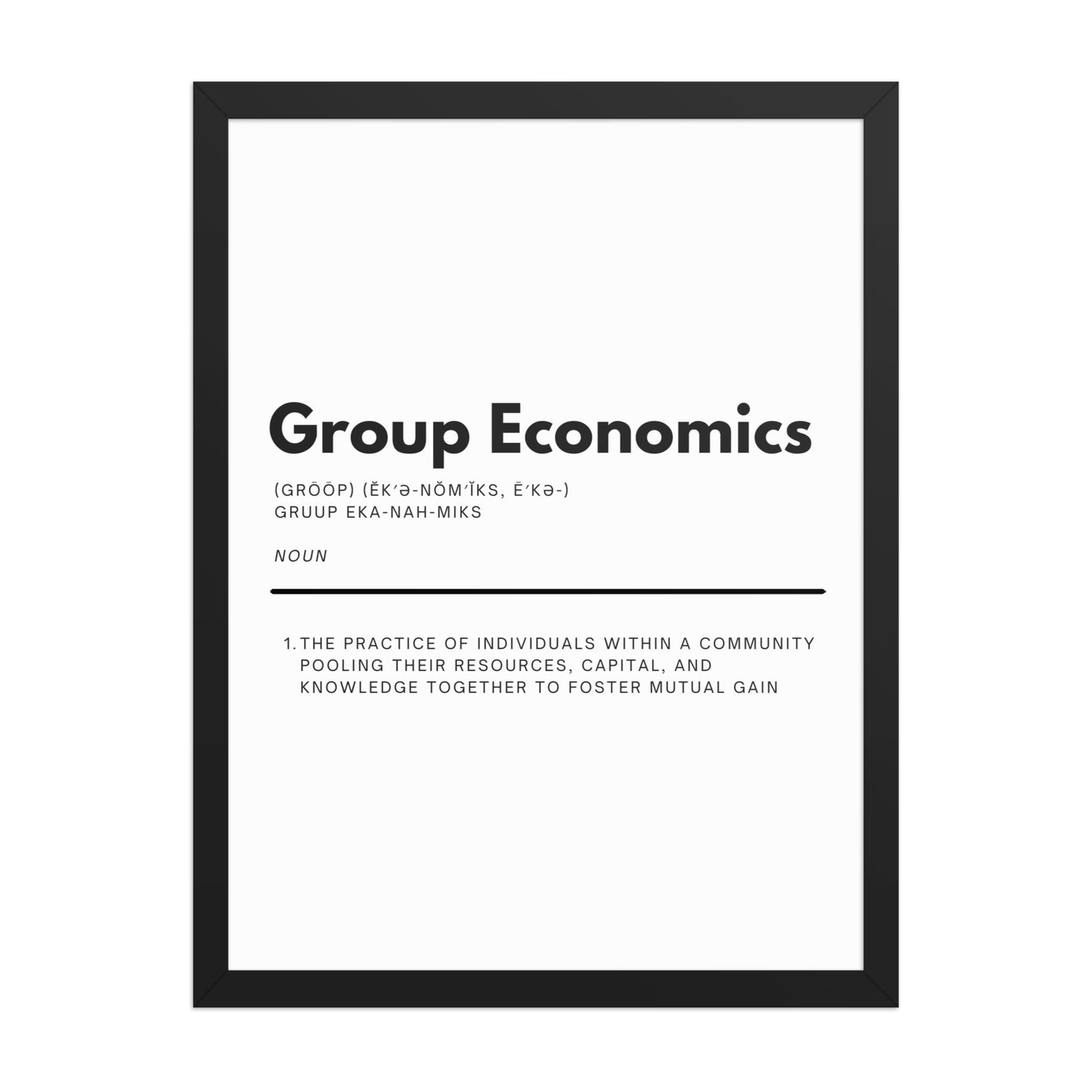
The Group Economics Definition Poster is a powerful visual reminder of the importance of cooperation, collective responsibility, and economic unity within a community. Designed to inspire conversation and awareness, this poster clearly presents the definition of group economics in a clean, impactful layout that fits perfectly in homes, offices, classrooms, community centers, and creative spaces.
Group economics is the principle of supporting and circulating resources within a community to strengthen collective prosperity. When individuals work together—supporting businesses, sharing knowledge, and reinvesting in one another—communities become more resilient, empowered, and self-sustaining.
This poster serves as a daily reminder of that philosophy.
Why This Poster Matters:
Reinforces the principle of economic cooperation
Encourages community awareness and financial consciousness
Sparks meaningful discussions about ownership, support, and unity
Ideal for educational spaces, offices, and entrepreneurial environments
Make a statement in any room with this framed poster, printed on thick matte paper. The matte black frame that's made from wood from renewable forests adds an extra touch of class.
• Ayous wood .75″ (1.9 cm) thick frame from renewable forests
• Paper thickness: 10.3 mil (0.26 mm)
• Paper weight: 189 g/m²
• Lightweight
• Acrylite front protector
• Hanging hardware included
• Blank product components in the US sourced from Japan and the US
• Blank product components in the EU sourced from Japan and Latvia
How to attach hooks on 24″ × 36″ horizontal frames:
Place each of the mounting hooks 1 inch (2.5 cm) from frame corners when hanging horizontally.
This product is made especially for you as soon as you place an order, which is why it takes us a bit longer to deliver it to you. Making products on demand instead of in bulk helps reduce overproduction, so thank you for making thoughtful purchasing decisions!
View full details
The Group Economics Definition Poster is a powerful visual reminder of the importance of cooperation, collective responsibility, and economic unity within a community. Designed to inspire conversation and awareness, this poster clearly presents the definition of group economics in a clean, impactful layout that fits perfectly in homes, offices, classrooms, community centers, and creative spaces.
Group economics is the principle of supporting and circulating resources within a community to strengthen collective prosperity. When individuals work together—supporting businesses, sharing knowledge, and reinvesting in one another—communities become more resilient, empowered, and self-sustaining.
This poster serves as a daily reminder of that philosophy.
Why This Poster Matters:
Reinforces the principle of economic cooperation
Encourages community awareness and financial consciousness
Sparks meaningful discussions about ownership, support, and unity
Ideal for educational spaces, offices, and entrepreneurial environments
Make a statement in any room with this framed poster, printed on thick matte paper. The matte black frame that's made from wood from renewable forests adds an extra touch of class.
• Ayous wood .75″ (1.9 cm) thick frame from renewable forests
• Paper thickness: 10.3 mil (0.26 mm)
• Paper weight: 189 g/m²
• Lightweight
• Acrylite front protector
• Hanging hardware included
• Blank product components in the US sourced from Japan and the US
• Blank product components in the EU sourced from Japan and Latvia
How to attach hooks on 24″ × 36″ horizontal frames:
Place each of the mounting hooks 1 inch (2.5 cm) from frame corners when hanging horizontally.
This product is made especially for you as soon as you place an order, which is why it takes us a bit longer to deliver it to you. Making products on demand instead of in bulk helps reduce overproduction, so thank you for making thoughtful purchasing decisions!